


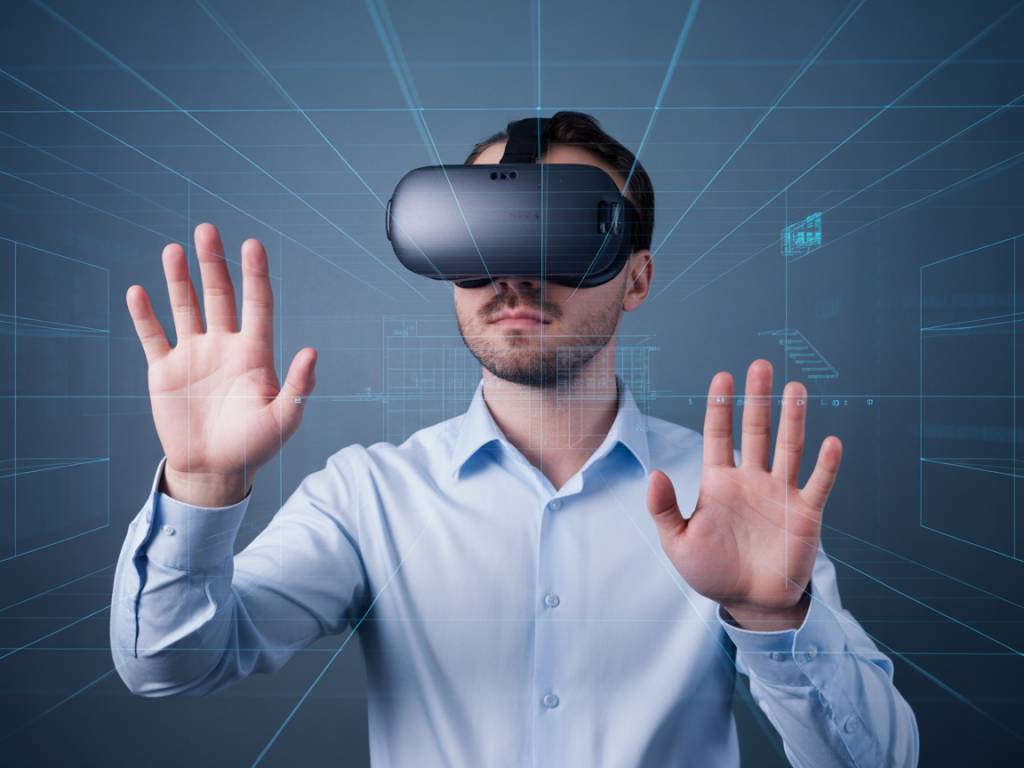
Somewhere in a half-lit meeting room in Manchester, six people in high-vis jackets are standing still, each wearing a black headset. They look faintly ridiculous. Yet, in that moment, they are walking through a building that does not yet exist.
The staircase they are “climbing” is only a model. The steel beams above their heads are still a line item on a procurement spreadsheet. The reception desk where the client pauses – “Can we move this two metres to the left?” – is nothing more than data, geometry and intention.
This is virtual reality in BIM. And for UK businesses, it’s quietly changing how buildings are imagined, sold, built and operated.
What is VR in BIM, really?
At its simplest, BIM (Building Information Modelling) is a smart 3D model that knows what it is. A wall isn’t just a rectangle; it has materials, fire ratings, cost, maintenance data. A door isn’t just a hole; it has hardware, access rules, lifecycle information.
Virtual reality (VR) takes that intelligent model and drops you inside it at full scale.
Instead of orbiting around a 3D model on a screen, you are standing in the lobby. You’re looking down the corridor. You’re checking if that meeting room really feels like it could host eight people and not just eight chairs.
Technically, VR in BIM means connecting your BIM authoring or coordination tools (Revit, Archicad, Navisworks, Vectorworks, etc.) to a VR platform that can:
- Read the BIM geometry and metadata
- Render the model in real time at 1:1 scale
- Let users navigate and interact (walk, teleport, measure, annotate)
- Optionally sync comments or changes back to the BIM environment
The result? A shared, immersive space where architects, contractors, clients and end-users can all inhabit the same future building, before a single brick or steel beam has been installed.
Why this matters to UK businesses now
In the UK, BIM is no longer an exotic acronym. Government mandates have pushed it into the mainstream of public sector projects. Major contractors and consultancies live and breathe it. But for many businesses – especially clients and occupiers – BIM still feels like something the “tech people” handle.
VR acts as a bridge.
Most non-technical stakeholders don’t think in plans and sections. They think in space, light, distance and noise. They think in “Can I see the reception from the lift?” and “Will this lab bench be easy to clean around?”
By stepping into a BIM model in VR, abstract information becomes intuitive:
- Board directors can sense if a proposed HQ feels premium or cramped
- Healthcare staff can test patient flows rather than guess from diagrams
- Retail teams can judge sightlines, signage and merchandising at eye level
- Facilities managers can check access to plant rooms and maintenance zones
At a time when UK businesses are wrestling with hybrid work, rising construction costs and aggressive sustainability targets, the ability to “test-drive” a building before it’s built is more than a novelty. It’s risk management.
Core VR applications within BIM workflows
So what do UK businesses actually do with VR in a BIM context? The glamour shots might show people waving controllers, but the real value is quieter, and more practical.
Design reviews that everyone understands
Traditional design reviews involve drawings pinned to walls, PDFs on screen, maybe a 3D model spinning on a projector. It’s easy for critical details to be missed, especially by non-designers.
With VR, design reviews become embodied:
- Teams explore spaces together at 1:1 scale
- Obvious issues emerge quickly – low ceilings, awkward columns, dark corners
- Alternative layouts can be tested in real time
- Comments can be pinned inside the model as notes or screenshots
On a speculative office development in Birmingham, one project manager described their first VR session as “like turning the lights on in the project”. People who had been politely nodding at drawings suddenly became vocal: “This corridor feels like a back-of-house route, not something we show clients.” The design shifted that afternoon.
Stakeholder engagement and consultation
Public consultations and stakeholder workshops can be hard work. You’re asking people to care about a building that only exists as flat drawings or glossy renders.
Drop them into VR and the conversation changes.
For local authorities, housing associations and campus developers, VR from BIM models can support:
- Community engagement events, letting residents walk through proposed schemes
- End-user feedback on layouts – nurses on ward designs, students on study spaces
- Investor tours of developments long before topping out
- Tenant fit-out planning for commercial leasing
One UK university used VR to show academic staff through a new research building directly from the BIM model. Rather than vague comments about “more collaboration space”, the conversation became about specific nooks, sightlines and adjacencies. Minor layout changes avoided major dissatisfaction later.
Clash detection and buildability
BIM already supports clash detection – identifying where elements intersect or conflict. But the leap from a clash report to a mental picture of the problem can be surprisingly steep.
In VR, those issues become painfully obvious. You aren’t looking at a coloured box labelled “ductwork clash”; you’re standing in the plant room, staring at a duct that slices through a beam.
Contractors and design teams use VR to:
- Review complex MEP (mechanical, electrical, plumbing) zones at full scale
- Assess maintenance access – “Can someone actually reach that valve?”
- Check construction sequencing visually
- Spot health and safety risks earlier in the design
On infrastructure-adjacent projects – rail stations, data centres, energy facilities – this early understanding can save weeks of rework and eye-watering sums.
Training, onboarding and safety
Once the BIM model exists, it isn’t just for design. It’s a rehearsal space.
VR environments derived from BIM let businesses:
- Train operations staff on new layouts before handover
- Familiarise security teams with evacuation routes
- Rehearse maintenance tasks in constrained spaces
- Simulate emergency scenarios without real-world risk
For a new hospital wing or logistics hub, that head start can mean smoother opening weeks and fewer costly mistakes.
Facilities management and digital twins
When the dust has settled and the ribbon is cut, the value of VR doesn’t have to stop.
If the BIM model evolves into a digital twin – a living, data-rich representation of the building in operation – VR offers a new lens for facilities teams:
- Visualise assets and maintenance tasks in situ
- Plan refurbishments or reconfigurations with minimal disruption
- Test energy-saving measures (layout, shading, occupancy patterns) spatially
- Communicate building changes to occupants in an intuitive way
Imagine planning a deep retrofit of a 1970s office block in Leeds: insulation upgrades, new HVAC, updated cores. Overlay the proposed BIM model on the existing one, then walk through both in VR. Suddenly, the business case for disruption is no longer an abstract ROI; it’s tangible experience.
Sector stories: where UK businesses are already using VR and BIM
Some sectors have been early, some are catching up fast. A few examples from across the UK landscape:
Commercial offices and hybrid work
- Developers use VR to help corporate tenants choose floorplates, test desk layouts and sense how hybrid teams might inhabit the space
- HR and workplace teams evaluate wellbeing features – natural light, quiet zones, informal meeting spots – from inside the model
Healthcare and life sciences
- Hospitals involve clinicians in VR walk-throughs of wards, theatres and labs sourced from BIM models, refining flows and ergonomics
- Life sciences campuses use VR to sell space to tenants and test highly serviced lab layouts before committing to expensive MEP
Housing and regeneration
- Local authorities visualise estate regeneration schemes in VR to support resident consultation and build trust
- Modular housing providers use VR from BIM to standardise components while allowing clients to experience customisation options
Industrial, logistics and infrastructure
- Logistics operators walk routes from dock doors to racking to packing lines, optimising circulation and safety
- Energy and transport projects use VR to understand complex interfaces, access needs and long-term maintenance strategies
Beneath the variety, the pattern is similar: BIM provides the structured data; VR provides the human understanding.
What about sustainability and “eco” performance?
It’s tempting to see VR as inherently energy-hungry and frivolous. Yet, when grounded in BIM, it can be a surprisingly sharp sustainability tool.
VR won’t calculate your operational carbon, but it can dramatically improve the quality of the decisions that drive it:
- Design teams can walk façades and shading strategies, judging glare and daylight more intuitively
- Clients can experience the difference between a lean, efficient floorplate and a sprawling one
- Refurbishment options can be explored in VR, making reuse and retrofit feel more concrete than demolition and rebuild
- Occupant-focused energy strategies – mixed-mode ventilation, shared spaces – can be tested experientially
Combine this with BIM-based energy analysis, and suddenly you have both the numbers and the narrative: data to prove a design is efficient, and VR to help decision-makers actually feel the impact of those choices.
Implementing VR in BIM workflows: a pragmatic path
For many UK SMEs, the fear is that VR means expensive hardware, complex integrations and an army of specialists. That used to be true. It isn’t anymore.
A typical starting roadmap looks like this:
1. Start with a single pilot project
- Pick a project where stakeholder engagement or design risk is high
- Define a simple goal: “We want one VR review per design stage with the client”
- Ring-fence a modest budget and clear responsibilities
2. Choose the right tools, not the fanciest
- Look for VR platforms that integrate cleanly with your existing BIM tools
- Decide whether you need live-link (model updates instantly) or periodic exports
- Consider whether you want room-scale VR, desktop VR, or even browser-based “VR-lite” for broader access
3. Invest in a usable, not extreme, hardware setup
- A small dedicated VR room with a capable PC and a couple of headsets is often enough
- All-in-one headsets can work, but ensure your chosen BIM/VR workflow supports them
- Focus on reliability and ease of use over chasing the absolute highest resolution
4. Curate the experience
- Don’t just drop clients into VR and hope for the best
- Plan a route through the building – key spaces, pinch points, decision areas
- Assign a facilitator to guide, record comments and ensure people are comfortable
5. Close the loop with BIM
- Capture decisions made in VR and track them in your BIM environment and CDE
- Standardise how VR feedback is recorded (screenshots, issue tracking, timestamps)
- Review, after each project phase, how VR actually changed outcomes
The technology stack matters, but the real transformation is cultural: moving from “presenting” buildings to “walking them together”.
Challenges and limits to keep in sight
VR in BIM is not a magic wand. Some of its limitations are worth naming openly.
Model quality is everything
VR will enthusiastically reveal every shortcut in your BIM model. Missing ceilings, floating doors, proxy objects that bear no resemblance to reality – they all become glaring distractions. Robust modelling standards and QA are essential before you invite clients in.
Not everyone loves headsets
Motion sickness, claustrophobia, simple unfamiliarity – these are real issues. Offer short sessions. Provide breaks. Always have a non-VR option (screen sharing the VR view, for example) so people can participate without wearing a headset.
The time cost is front-loaded
Early on, export pipelines, performance optimisation and model simplification (LOD, textures, lighting) can feel like friction. Over time, templates and internal best practices reduce that pain. But it is there, and it needs resourcing.
VR can seduce you into surface-level judgement
A space that looks beautiful in VR is not necessarily functional, affordable or efficient. VR should augment, not replace, engineering analysis, cost planning and operational modelling. Think of it as another viewpoint on the same data, not the ultimate arbiter.
Where this is heading for UK businesses
We are still in the early chapters of this story. VR is already starting to blend with other technologies orbiting BIM:
- Mixed reality (MR) allows site teams to overlay BIM models on physical construction, spotting deviations in real time
- AR on mobile devices lets facilities staff “see” hidden services while standing in finished spaces
- AI-driven optimisation can iterate layout options inside BIM, then serve up the best options for VR review
- Cloud collaboration lets distributed teams inhabit the same virtual building from different cities, or continents
For UK businesses, the competitive edge won’t come from buying the shiniest headset. It will come from:
- Using VR to take the abstraction out of major capital decisions
- Bringing end-users and operators into the conversation early, via the BIM model
- De-risking complex projects through better shared understanding
- Telling clearer stories about value, sustainability and experience
In a sense, VR simply allows BIM to do what it always promised: make buildings more knowable before they exist.
The future HQ, the next outpatient clinic, the refurbished warehouse-turned-innovation-hub on the edge of a Northern city – all of them begin life as dense clouds of data in a BIM environment. VR gives that data a human scale. It lets the people who will fund, build and inhabit these places take a quiet walk through tomorrow, while there is still time to change it.