


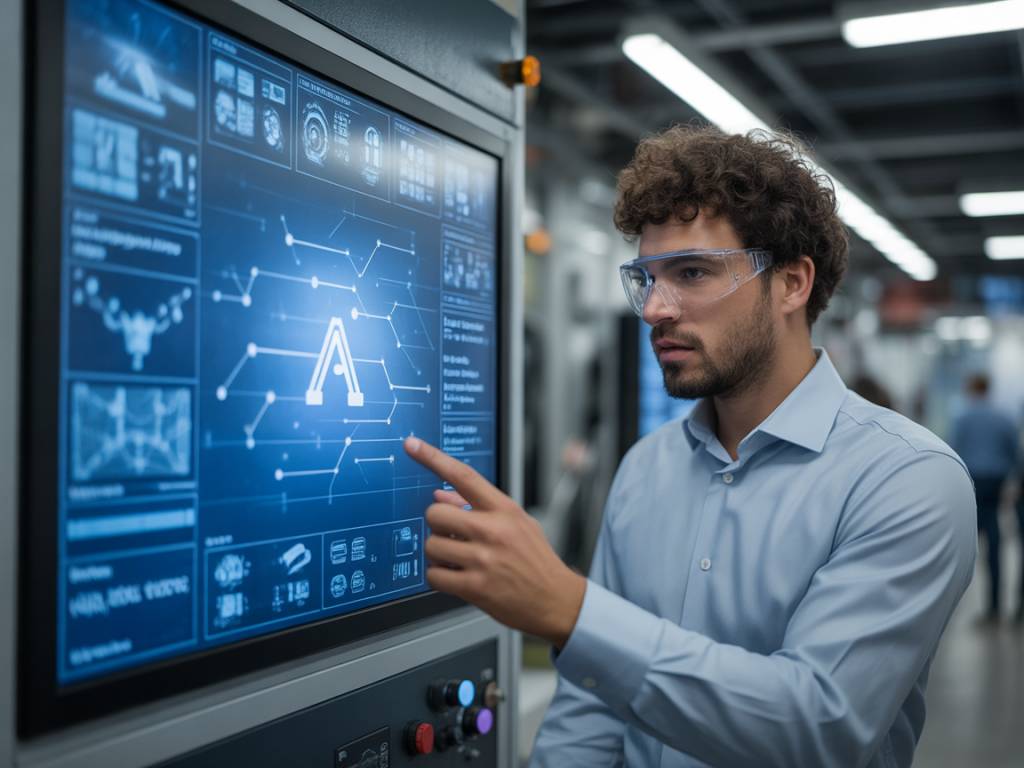
On a grey Tuesday morning in Birmingham, a robotic arm pauses mid-air, hesitates for a fraction of a second, then chooses a different bolt. Not because an engineer reprogrammed it overnight, but because a machine-learning model, fed by thousands of micro-errors across three factories, decided that this bolt will reduce defects by 0.7%.
On that same morning in Ohio, a logistics planner opens a dashboard that quietly suggests rerouting a shipment through a different port. Not due to a human hunch, but because an AI system has been watching weather patterns, labour strikes, fuel prices and port congestion, and has stitched them into a single recommendation: “Go via Baltimore. Save three days. Save $42,000.”
This is where the story of UK–US industry and artificial intelligence really lives: not in abstract talk of “disruption”, but in these almost invisible micro-decisions that, added together, redraw the map of transatlantic manufacturing and services.
From smokestacks to server racks
For two centuries, industry between the UK and the US has been a physical affair: coal, steel, containers, cables stretching under the Atlantic. Today, the most valuable cargo moving between the two economies is data.
Manufacturers and service companies on both sides are discovering a simple, unsettling truth: the competitive gap is no longer just about cheaper labour or better machines, but about who learns faster from their own operations. That’s all AI really is in an industrial context: a learning loop, accelerated.
In the UK, this is amplified by the country’s dense network of mid-sized industrial cities—Sheffield, Coventry, Bristol—where legacy systems still hum alongside newer cloud platforms. In the US, scale dominates: sprawling plants in the Midwest, fulfilment centres stretching like airfields across Texas and Pennsylvania.
AI, awkwardly at first, is becoming the shared language between them.
Smart factories, shared lessons
One of the most tangible shifts is in the factory itself. The stereotypical image of AI is a glowing dashboard; the reality is a slightly less broken production line.
Across the UK and US, three families of applications are emerging again and again:
- Predictive maintenance: Sensors on machines stream vibration, temperature and acoustic data into models that spot early signs of failure. Rolls-Royce’s “power-by-the-hour” model for engines is famous, but similar ideas now run in small plastics plants in Yorkshire and metal workshops in Indiana.
- Quality control by camera: Computer vision systems inspect welds, paint jobs and tiny defects humans miss at speed. A London-based startup helps US automotive suppliers reduce recall risk by catching microscopic imperfections, frame by frame.
- Demand-aware production: AI models forecast orders not from a single Excel sheet, but from weather, promotions, social media patterns, macroeconomic data and historical demand. The result is fewer “heroic” last-minute overtime shifts and less capital frozen in warehouses.
The most interesting part? These systems increasingly learn across borders. A predictive maintenance model trained on gearboxes in a Scottish wind farm might improve uptime for similar equipment in an Iowa plant. Data doesn’t need a visa.
This cross-pollination is quietly building a transatlantic industrial brain: distributed, constantly updated, and indifferent to flags.
Services go algorithmic
Manufacturing gets the glamorous robots, but services are where AI’s impact may run deepest between the UK and US.
Take financial services. London and New York, two cities that already trade staff, regulation headaches and red-eye flights, now trade AI models. Fraud detection tools trained on patterns in one market adapt to the other, spotting oddly-timed transactions or synthetic identities before humans can blink.
Insurance underwriters from the City talk with their counterparts in Connecticut about risk models that ingest satellite imagery, climate projections and real-time industrial sensor data from clients’ facilities. Underwriting becomes less about static paperwork and more about living risk profiles.
Or look at logistics and retail. A UK retailer using AI to optimise picking routes in a Milton Keynes fulfilment centre may license the same system to a US partner operating out of New Jersey. The software doesn’t care whether the parcel is going to Manchester or Milwaukee; it only cares about seconds saved.
Even professional services—law, consulting, engineering—are feeling the tremor. Document review, contract analysis and compliance checks are being augmented by language models that can digest transatlantic regulation far faster than a junior associate. The firms that acknowledge this early are quietly redesigning what “entry-level work” means.
City as laboratory, city as mirror
Industrial AI doesn’t live in isolation; it feeds off cities. There’s a reason why so many AI-for-industry firms sprout in places like London, Cambridge, Manchester, Boston, Austin, Pittsburgh.
These cities offer three raw materials no algorithm can synthesise on its own:
- Talent density: Universities, research labs, and corporates create a loop of ideas and spin-outs. The University of Cambridge partners with manufacturers in the Midlands; MIT and Carnegie Mellon do the same with plants in the American heartland.
- Data ecosystems: Ports, airports, utilities and transport systems generate vast data streams. Startups and corporates tap these to train systems that later migrate into factories, warehouses and offices.
- Regulatory sandboxes: The UK’s tradition of “regulatory sandboxes” in fintech is leaking into AI, allowing controlled experimentation; some US states are following with their own frameworks.
In this sense, AI in industry is not just an engineering story; it is a city story. When a warehouse in Leeds adopts a US-built optimisation engine, or a Boston-based medtech startup deploys an NHS-tested triage model, each city becomes a mirror for the other’s experiments.
Decarbonisation: when AI meets carbon accounting
No serious conversation about modern industry—on either side of the Atlantic—can ignore carbon. Here, AI sits in an uncomfortable but powerful position: it both consumes significant energy and helps reduce emissions.
In heavy industry, transatlantic collaborations are emerging around energy optimisation. A British chemicals plant might share anonymised operating data with a US research team building models that minimise energy use while keeping yield constant. The reward: lower energy bills and real progress toward net-zero targets.
Grid operators, too, are leaning heavily on AI. Balancing intermittent wind in the North Sea with solar in California and Texas may seem like two separate challenges, but the learning is shared. Forecasting models developed for UK offshore wind farms inform similar models used by US utilities, and vice versa.
On the corporate side, carbon accounting platforms now pull data from ERP systems, logistics records and IoT sensors in plants from Swindon to Seattle. AI reconciles messy datasets into something approaching a real-time carbon ledger. For global manufacturers that straddle both the UK and US, this makes reporting credible rather than cosmetic.
There is a quiet irony: code running in data centres, perhaps cooled by the North Sea or the Oregon air, is orchestrating the reduction of emissions from furnaces, fleets and factories. The industrial revolution, phase two, is mediated by APIs.
People in the loop, not out of the room
Whenever AI and industry are mentioned in the same breath, another word lurks nearby: jobs. Redundant. Automated. Displaced. The fears are not imaginary. But the emerging reality in UK–US industrial ties is subtler than a simple “robots take all”.
Across plants and offices, three patterns stand out:
- Task shift rather than role annihilation: Welders in a Detroit plant now supervise welding robots, focusing on complex joins and edge cases. In a Midlands aerospace shop, machinists spend more time on programming and quality checks than on raw cutting.
- Hybrid expertise: The most sought-after profiles can talk both to machines and to people: an operations manager who understands inference latency; a maintenance engineer who can read a loss function graph as comfortably as a blueprint.
- Retraining as competitive advantage: UK manufacturers working with US partners are setting up joint academies and cross-border training programmes where staff learn to work with AI tools, not around them.
Anecdotally, many firms first try to deploy AI as a top-down magic solution, only to hit resistance. The projects that stick usually start at the edge: a line supervisor in Sunderland who fine-tunes an anomaly detection model based on actual noise on the shop floor; a warehouse worker in New Jersey who suggests a better way to visualise route optimisation.
In both countries, the uncomfortable but necessary move is to treat frontline workers not as “to be replaced” but as co-designers. The best AI roll-outs look less like software installations and more like industrial anthropology.
Standards, safety nets and the law that lags
Innovation has a way of outrunning legislation. AI in industry is no exception, and the UK–US dynamic is becoming a live experiment in how two close, but not identical, regulatory cultures will shape the same technology.
The UK leans toward principle-based, sector-led guidance—light-touch, at least for now. The US, with its patchwork of federal agencies and state rules, creates a more fragmented landscape. For a multinational industrial company, this means a single AI system deployed in both markets may need different audit trails and explainability features depending on the jurisdiction.
Industrial safety standards are already evolving. When an AI system can autonomously adjust line speeds, who is responsible when something goes wrong—the vendor, the integrator, or the plant operator? Transatlantic industry bodies are beginning to craft shared standards for AI assurance, not out of academic curiosity but from commercial necessity. Shared supply chains don’t like regulatory surprises.
And then there’s the ethics question. Using AI to squeeze more productivity out of a machine is one thing; using it to monitor workers’ every movement, keystroke and gesture is another. Companies that operate in both the UK and US are already discovering that cultural tolerance for surveillance varies—and that reputational risk now travels faster than any audit report.
When data becomes a trade route
Trade agreements used to focus on tariffs, quotas and customs forms. Increasingly, the quiet negotiations that matter most for AI-driven industry involve something less visible: data access, data localisation, data protection.
A predictive model that optimises spare parts inventory across facilities in Manchester and Minnesota needs to learn from both. If regulations make that data cross-border flow too complex or risky, the model shrinks in intelligence. In other words, bad policy can literally make AI dumber.
Recent UK–US talks around data adequacy, transfer mechanisms and digital trade are more than diplomatic footnotes; they are the plumbing of the future industrial economy. Secure, lawful, and ethically sound data flows are fast becoming as vital as shipping lanes once were.
In this sense, chief data officers and compliance leads are the new trade negotiators inside companies. Their decisions determine whether a promising algorithm stays trapped in a single country or grows into a genuinely transatlantic capability.
Where to start: a practical lens for business leaders
If you run or influence an industrial or service business that touches both the UK and US, the AI landscape can feel like a swirl of buzzwords and pilot projects. A more grounded approach is to ask three deceptively simple questions:
- Where is reality messier than our spreadsheets suggest? That’s often where AI can help—complex demand patterns, erratic machine failures, hard-to-spot defects, sprawling service processes.
- What decisions do we make repeatedly, with incomplete information? Pricing, routing, staffing, maintenance scheduling—these are prime territories for decision-support systems.
- Where do we already have data, but no one has time to look at it? Sensor logs, customer interactions, supplier performance metrics, energy consumption records.
From there, the transatlantic advantage kicks in. UK pilots can be tested, iterated and pressure-tested in American contexts, and vice versa. Supplier ecosystems in both countries mean that, for almost any industrial AI problem, there is likely already a partner or platform that has seen something similar—across an ocean, if not next door.
The risk is not missing the single “killer app”; it is letting dozens of incremental opportunities slip because AI is framed as a future moonshot instead of a present tool.
In the end, the story of AI in UK–US industry may be less about grand disruption and more about compound improvement. A line runs slightly smoother in Derby. A call centre in Dallas resolves issues faster. A ship leaves Felixstowe a day earlier because a routing model in Chicago spotted a bottleneck. None of these moments will make headlines. Together, they redraw what industrial performance looks like across two of the world’s most closely entwined economies.
Some revolutions announce themselves with manifestos. This one arrives as a quiet suggestion from a dashboard that says, “Try it this way instead.” The question for businesses on both sides of the Atlantic is simple: who is listening—and who is still waiting for the future to knock louder?