


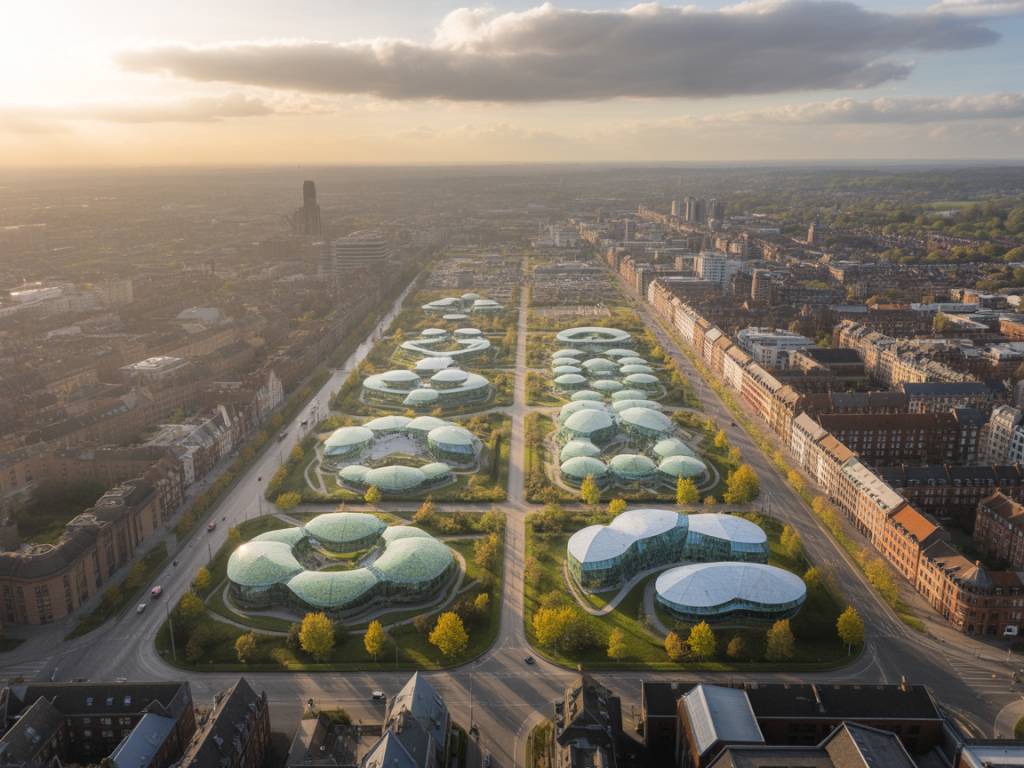
Why green innovation districts matter for UK mid-sized cities
Across the UK, mid-sized cities are turning to green innovation districts as a strategic way to drive sustainable growth, attract investment and create high-value jobs. While London, Manchester and Birmingham often dominate the headlines, cities such as Bristol, Nottingham, Coventry, Sheffield, Leicester and Glasgow are quietly building ecosystems that link universities, start-ups, established firms and public authorities around the shared objective of a low-carbon economy.
These emerging urban innovation districts specialise in areas such as renewable energy, clean mobility, circular economy solutions and green construction. They are designed not only as business clusters, but as places where infrastructure, planning, regulation and talent are deliberately aligned with the UK’s net zero ambitions.
For mid-sized cities seeking to reposition themselves after deindustrialisation, the green economy is no longer a niche: it is becoming a core pillar of their economic development strategies and a tool for place-based regeneration.
What is a green innovation district?
A green innovation district is a defined urban area where public authorities, universities, businesses and investors collaborate to accelerate the development and commercialisation of low-carbon technologies and sustainable business models. These districts typically combine physical infrastructure, regulatory support and research capacity with a strong emphasis on liveability and social value.
Common features of successful green innovation districts in the UK include:
- Proximity to universities and research centres, enabling collaboration on climate science, engineering, energy systems and environmental technologies.
- Flexible work and lab spaces designed for start-ups, spin-outs and scale-ups in sectors such as clean tech, green construction, sustainable materials and digital climate services.
- Low-carbon infrastructure on site, including district heating, renewable power generation, energy-efficient buildings and sustainable transport options.
- Targeted incentives from local authorities and national programmes to support research, demonstration projects and commercial deployment.
- Integrated planning and regeneration, where brownfield or former industrial areas are repurposed into mixed-use neighbourhoods that showcase sustainable living.
Because they are tightly focused on climate and environmental goals, these districts often act as real-world testbeds for UK-wide policies on decarbonisation, smart grids, nature-based solutions and circular economy practices.
Why mid-sized cities are well-placed to lead
Mid-sized UK cities typically have between 200,000 and 1 million residents. They are large enough to support diverse economies and research institutions, yet small enough for decision-makers to coordinate across sectors. This scale can be an advantage when it comes to building cohesive, mission-driven innovation districts.
Several structural factors explain why mid-sized cities are increasingly choosing to specialise in green innovation rather than competing head-on with larger metropolitan centres:
- Industrial heritage: Many of these cities have a legacy in manufacturing, engineering and automotive industries. This provides both a challenge, due to carbon-intensive assets, and an opportunity, as existing skills and supply chains can be redirected towards clean technologies.
- Available land: Former industrial sites and docklands provide brownfield land that can be transformed into low-carbon districts with modern infrastructure.
- Anchor institutions: Universities and research institutes located in mid-sized cities play a central role in climate research, energy systems modelling, materials science and environmental engineering.
- Cost competitiveness: Lower commercial property costs and living expenses compared with London and the South East can make it easier to attract and retain start-ups and technical talent.
- Local leadership: City councils and combined authorities can move relatively quickly to create place-based strategies, use planning powers and direct public investment towards net zero objectives.
These advantages are increasingly reflected in local industrial strategies and climate action plans, which frame green innovation districts as engines for inclusive, long-term growth.
Key examples across the UK
While there is no single model, several UK mid-sized cities provide concrete illustrations of how green innovation districts are taking shape and influencing local economies.
Bristol: Temple Quarter and city-wide climate innovation
Bristol has positioned itself as a leading UK city for climate innovation. The Temple Quarter regeneration area, near the main railway station, is evolving into a mixed-use innovation district with strong emphasis on sustainable mobility, smart energy systems and low-carbon construction. The presence of the University of Bristol and a growing ecosystem of clean tech companies supports a focus on environmental data, urban resilience and digital tools for decarbonisation.
Across the city, initiatives on community energy, retrofit programmes and sustainable transport provide a living laboratory that complements the more formal district-based innovation strategy.
Nottingham: energy transformation and heat networks
Nottingham is working to become a net zero city by 2028, one of the most ambitious timelines in the UK. Its emerging green innovation district activity is concentrated around energy, with investments in district heating, deep retrofit of social housing and deployment of solar PV across public buildings.
The city’s universities and enterprises are developing expertise in energy efficiency, building performance and smart thermal networks. These capabilities are embedding a new specialisation in low-carbon urban infrastructure that has potential export value to other UK cities and international markets.
Coventry: green mobility and advanced manufacturing
Coventry’s plans for a green innovation district are deeply linked to its automotive heritage. The city has become a focal point for research into electric vehicles (EVs), battery technology and autonomous transport. Collaboration between Coventry University, the manufacturing supply chain and local authorities is driving the design of testbeds for connected and autonomous vehicles, as well as advanced propulsion systems.
This focus on green mobility is intended to secure the city’s role in the future automotive ecosystem, while applying its existing industrial strengths to low-carbon transport solutions.
Sheffield and the North: green materials and manufacturing
Sheffield’s industrial innovation district, building on the Advanced Manufacturing Research Centre (AMRC) and the University of Sheffield, is increasingly integrating sustainability into advanced manufacturing and materials science. From low-carbon steel processes to lightweight materials for renewables, the region is aiming to translate its engineering heritage into climate-aligned production systems.
Other northern mid-sized cities, including Hull and Sunderland, are following similar paths, with specialisations in offshore wind, hydrogen and energy storage forming the backbone of local green innovation strategies.
Policy drivers and funding mechanisms
The development of green innovation districts in UK mid-sized cities is supported and shaped by a mix of national policy, devolved powers and local initiatives. Key drivers include:
- UK net zero legislation: The statutory commitment to reach net zero greenhouse gas emissions by 2050 serves as a long-term signal that decarbonisation is a national priority.
- Local industrial strategies: City regions are using industrial strategies to identify priority sectors, align skills programmes and attract inward investment focused on green growth.
- Research and innovation funding: UK Research and Innovation (UKRI), Innovate UK and other public bodies provide grants for demonstration projects, academic-industry collaboration and scaling of climate innovations.
- Levelling Up and regeneration funds: Programmes associated with levelling up and town centre regeneration are being directed towards low-carbon infrastructure and innovation assets within city districts.
- Public procurement and planning: Local authorities are increasingly using procurement rules and planning frameworks to support low-carbon design, circular economy practices and sustainable building standards in new developments.
These instruments, when combined, create an enabling environment in which mid-sized cities can systematically embed sustainability into their economic development strategies.
Economic and social impacts of green innovation districts
The economic rationale for green innovation districts goes beyond emissions reduction. For mid-sized cities facing productivity gaps, skills challenges and uneven patterns of growth, these districts can deliver a number of tangible benefits.
- High-value job creation: Clean tech, digital climate services, advanced engineering and environmental consultancy are all sectors associated with higher-than-average wages and strong export potential.
- Business formation and scaling: Concentrating support services, labs and testbeds in a specific area can increase the success rate of start-ups and help local SMEs adopt low-carbon technologies.
- Attracting investment: International investors and large corporates are seeking credible, climate-aligned locations for R&D and manufacturing. Clear place-based strategies and visible districts can make mid-sized cities more competitive.
- Urban regeneration: Repurposing derelict or underused sites into green innovation districts can unlock land value, improve public space and strengthen local identity.
- Skills and inclusion: Collaborations between training providers, universities and employers within districts can create pathways into green jobs for local residents, including those currently under-represented in STEM fields.
When designed with social equity in mind, green innovation districts can thus contribute to a more inclusive and resilient local economy.
Challenges and risks for mid-sized cities
Despite the momentum behind green innovation districts, mid-sized UK cities face significant challenges in delivering on their ambitions.
- Fragmented funding: Short-term, project-based funding can make it difficult to plan multi-decade transformations of urban districts and industrial systems.
- Competition for talent: Larger cities and global hubs often attract skilled workers in engineering, data science and climate policy, leaving smaller cities with gaps that constrain growth.
- Infrastructure lock-in: Existing energy, transport and building stock may be carbon-intensive and costly to retrofit, slowing the pace of change.
- Risk of displacement: Upgrading districts and attracting high-value businesses can drive up property values and risk displacing local communities if social safeguards are weak.
- Scaling innovation: Translating successful pilots into city-wide or regional roll-out remains a complex task, requiring coordination across sectors and governance levels.
Addressing these risks requires long-term governance arrangements, active community engagement and stable policy frameworks that transcend electoral cycles.
The next phase: integrating climate innovation into whole-city strategies
For mid-sized UK cities, the emergence of green innovation districts is often just the first stage. The long-term challenge is to ensure that the innovations developed within these districts are widely adopted across the city’s housing, transport, industry and public services.
Several strategic shifts are likely to characterise the next phase of development:
- From isolated projects to systemic change: Innovation districts will increasingly be evaluated on their contribution to city-wide emissions reductions, resilience and social outcomes.
- Deeper integration with digital technologies: Data platforms, AI-enabled optimisation and smart grids will play a growing role in managing energy, mobility and resource flows.
- Stronger regional collaboration: Mid-sized cities may form networks to share best practice, coordinate supply chains and jointly attract investment in areas like hydrogen, offshore wind or battery manufacturing.
- Community-focused innovation: Citizen-led projects, social enterprises and co-operatives are likely to become more visible within districts, helping align technological innovation with local needs.
As the UK continues to navigate the economic and environmental transitions of the coming decades, the experience of its mid-sized cities will be critical. Their green innovation districts offer a window into how place-based strategies, when coupled with robust climate goals, can shape new models of sustainable growth that are both locally grounded and globally relevant.