


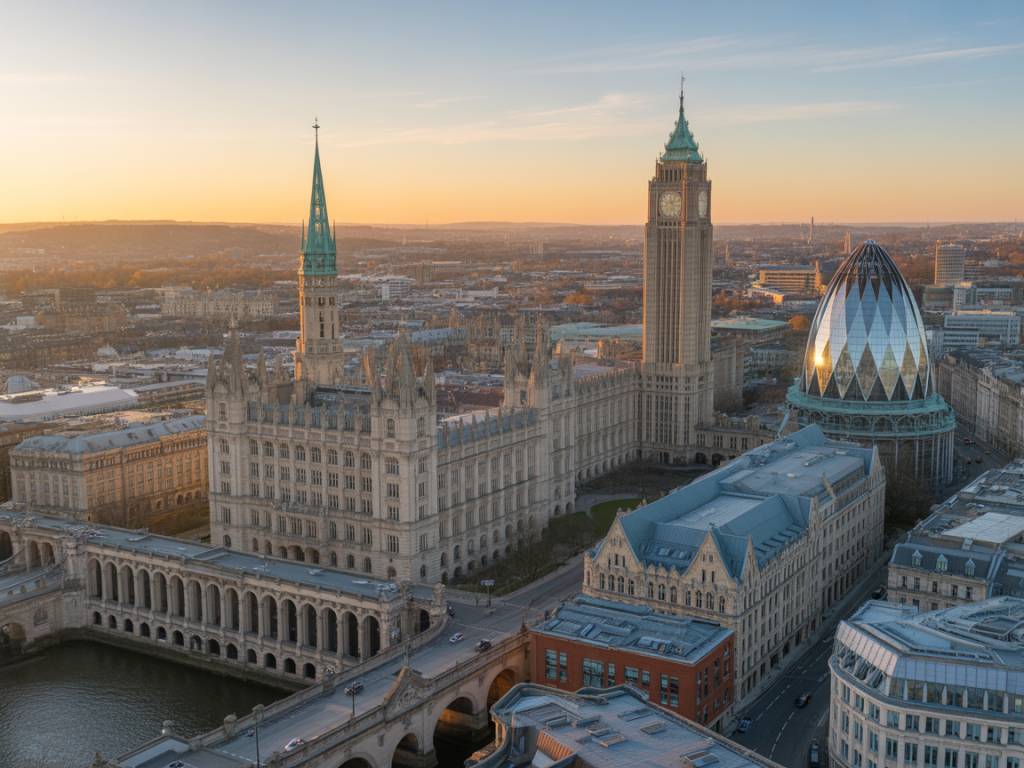
Rethinking the UK growth map: the rise of mid-sized cities
For decades, the economic narrative of the United Kingdom has revolved around London and a handful of major metropolitan areas. Yet beneath the headline data, a quieter transformation is underway. A network of UK mid-sized cities – places like Nottingham, Reading, Coventry, Exeter, Derby, and Dundee – is emerging as a powerful engine of innovation and sustainable growth. These “hidden champions” are increasingly central to regional development strategies, clean-tech investment, and inclusive economic renewal.
As debates over regional inequality, productivity gaps, and the green transition intensify, understanding the role of these mid-sized cities is no longer a niche interest. It is becoming a key to understanding how the UK can deliver higher-value jobs, resilient local economies, and a more balanced pattern of national growth.
What defines a UK mid-sized city in the new economic landscape?
There is no single, universally accepted definition of a “mid-sized city”, but in the UK context it generally refers to urban areas with populations between roughly 150,000 and 500,000, often serving as regional hubs for services, manufacturing, higher education, and logistics.
Unlike global mega-hubs, these cities tend to have:
- More affordable housing and office space
- Shorter commute times and less congestion
- Close links to rural and coastal economies
- Tight-knit business communities and civic networks
Far from being “smaller versions” of the largest cities, mid-sized cities often combine a dense concentration of knowledge, research and specialist skills with a highly liveable environment. That combination is proving particularly attractive for sectors aligned with sustainable growth: green technologies, digital services, advanced manufacturing, and health innovation.
Innovation ecosystems beyond the usual suspects
The innovation economy in the UK is still frequently associated with London, Cambridge, Oxford, and a few large metropolitan areas. Yet mid-sized cities are building distinctive innovation ecosystems of their own – often with a sharper focus on applied research and industrial transformation.
Several factors are driving this shift:
- Universities and colleges as anchor institutions – Many mid-sized cities host universities with strong research capabilities in engineering, life sciences, environmental technology or data science. These institutions act as anchors, attracting talent, research grants and industry partnerships.
- Specialist clusters and sector strengths – Rather than trying to replicate the London model, mid-sized cities are cultivating specialist niches: low-carbon transport in Coventry, data and fintech in Leeds, marine renewables in Plymouth, or digital health in Dundee.
- Incubators, accelerators and science parks – Local authorities and universities are investing in innovation infrastructure that supports start-ups and scale-ups, from shared labs and maker spaces to business accelerators and testbeds for emerging technologies.
- Stronger town–gown collaboration – Compared with some larger cities, mid-sized places often benefit from more direct, flexible collaboration between local government, universities and business groups, allowing faster experimentation and partnership-building.
The result is a distributed but interconnected network of innovation hubs that can complement, rather than compete directly with, the largest cities. For companies seeking lower costs, specialised talent and access to test markets, these locations are increasingly compelling.
Mid-sized cities at the forefront of sustainable growth
Sustainable growth is no longer a buzzword; it is a strategic imperative for governments, investors and companies. UK mid-sized cities are using the transition to a low-carbon, resource-efficient economy as a pathway to higher productivity and differentiated competitive advantage.
Several features explain why these cities are especially well-suited to driving the green economy:
- Scale that enables whole-city transitions – Mid-sized urban areas are large enough to have complex infrastructures, yet small enough to pilot city-wide climate strategies, smart energy systems and sustainable mobility schemes in a manageable way.
- Legacy industrial strengths – Former industrial centres such as Derby, Sunderland or Stoke-on-Trent are repurposing engineering and manufacturing expertise for renewable energy components, electric vehicles, advanced materials and circular economy business models.
- Proximity to natural assets – Cities located near coastlines, rivers, or extensive rural hinterlands can leverage their geography for offshore wind services, tidal power research, agritech, or nature-based solutions to climate risks.
- Integrated planning and regeneration – Regeneration projects in mid-sized cities are increasingly linked to net zero goals, from low-carbon housing and district heating to green corridors, active travel infrastructure and climate-resilient public spaces.
These dynamics are reshaping how local authorities plan infrastructure and economic development, aligning climate targets with job creation in sectors such as construction, retrofitting, energy efficiency, clean transport and digital infrastructure.
Talent, quality of life and the post-pandemic rebalancing
The shift to hybrid and remote work models, accelerated by the pandemic, has changed how knowledge workers think about location. While the largest cities retain a powerful pull, there is evidence of growing interest in mid-sized cities that offer attractive lifestyles, cultural amenities and good connectivity without the costs and pressures of mega-urban living.
UK mid-sized cities are increasingly used as examples of places that can offer:
- Access to green space and outdoor recreation
- Shorter, multimodal commutes compatible with climate goals
- A diverse housing stock at relatively lower prices
- Community-scale cultural and creative scenes, from music and festivals to independent food, art and design
This combination is particularly appealing to younger professionals, creative workers and families, helping employers in these locations attract and retain talent. As more high-value jobs become location-flexible, mid-sized cities stand to benefit from new waves of in-migration and business formation – provided that local infrastructure, digital connectivity and public services keep pace.
Levelling up, devolution and local leadership
National policy has also played a role in elevating the profile of mid-sized cities within the UK’s economic geography. The “levelling up” agenda and the expansion of devolution deals have given many of these cities greater responsibility – and in some cases greater resources – to shape their own development trajectories.
Key policy and governance trends include:
- Mayoral combined authorities – In areas such as the West Midlands, Greater Manchester and the Tees Valley, combined authorities provide a platform for coordinated transport, skills, housing and innovation policy, with mid-sized cities playing central roles.
- Local industrial strategies – Even where formal industrial strategies have evolved, many city-regions continue to use similar frameworks to align education, infrastructure and business support around priority sectors, often with a focus on clean growth and advanced industries.
- Place-based funding initiatives – Programmes targeting town centre regeneration, innovation infrastructure and net zero projects are increasingly being channelled into mid-sized cities, recognising their potential as catalysts for wider regional development.
Crucially, the effectiveness of these instruments often depends on local leadership. Cities that combine clear strategic vision with strong collaboration between councils, universities, business networks and community groups tend to move faster and attract larger volumes of private investment.
Challenges on the road to resilient, inclusive growth
The narrative of UK mid-sized cities as “hidden champions” should not obscure the structural challenges many of them face. Issues such as productivity gaps, underinvestment in infrastructure, skills mismatches and pockets of deep deprivation remain pressing.
Several barriers can hold back their full potential:
- Connectivity constraints – Rail, bus and active travel networks are often less integrated and less reliable than in larger cities, limiting labour market reach and discouraging investment, especially in peripheral neighbourhoods.
- Uneven digital infrastructure – While city centres may boast high-speed connectivity, outlying districts and surrounding rural areas can lag, undermining efforts to spread digital innovation.
- Limited institutional capacity – Smaller councils and economic development teams may struggle to manage complex, multi-partner projects, or to compete for national and international funding against better-resourced city-regions.
- Persistent inequalities – Many mid-sized cities grapple with health and income disparities, educational attainment gaps and ageing housing stock, making truly inclusive growth a demanding objective.
Addressing these issues requires sustained policy attention, long-term investment and a commitment to cross-sector collaboration. It also requires robust data, monitoring and evaluation to ensure that innovation and sustainability initiatives deliver real benefits for local residents.
Opportunities for business, investors and policymakers
Despite the challenges, the strategic opportunities associated with UK mid-sized cities are increasingly recognised by businesses and investors looking for new growth markets aligned with sustainability goals.
For companies and entrepreneurs, these cities offer:
- Access to specialist talent pools emerging from local universities and colleges
- Lower operating costs and more flexible urban environments for testing products and services
- Proximity to industrial supply chains in manufacturing, logistics and construction
- Partnership opportunities with local authorities on smart city, net zero and regeneration projects
For institutional and impact investors, mid-sized cities provide a pipeline of projects in areas such as energy efficiency, low-carbon transport, urban regeneration and innovation infrastructure – often underpinned by stable local demand and supportive policy frameworks.
For policymakers, the lesson is clear: a national strategy for innovation and sustainable growth that focuses solely on the very largest cities will miss a substantial share of the UK’s potential. Leveraging the distinct strengths of mid-sized cities – their scale, specialisation and community cohesion – offers a more diversified and resilient model of regional development.
From hidden champions to central pillars of the UK economy
The evolving role of UK mid-sized cities reflects a broader rethinking of what drives national prosperity. Innovation is no longer confined to a handful of metropolitan hotspots; sustainable growth is no longer an optional add-on to economic policy. Instead, both are increasingly embedded in the everyday fabric of mid-sized urban economies across the country.
As these cities deepen their sector specialisms, invest in green infrastructure, and cultivate vibrant, liveable environments, their position within the UK’s economic hierarchy is likely to strengthen. The question now is not whether UK mid-sized cities matter, but how quickly policy, investment and corporate strategies can adapt to recognise them as integral – not peripheral – to the country’s innovation capacity and sustainable growth trajectory.