


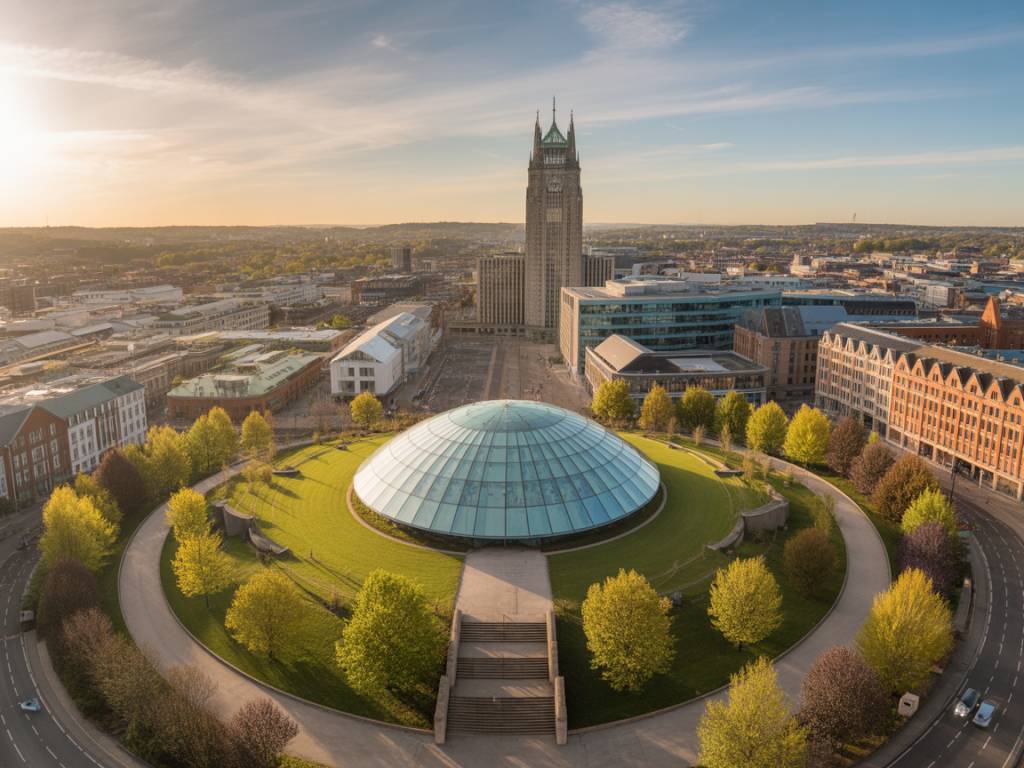
Nottingham’s Shift Toward a Low‑Carbon, Innovation‑Led Economy
Nottingham is steadily emerging as one of the UK’s most active mid-sized cities for green innovation. Long known for its industrial heritage and university research, the city is now positioning itself as a hub for clean technologies, circular economy models and low‑carbon services. Rather than relying on isolated initiatives, Nottingham is building an interconnected and sustainable innovation ecosystem designed to support green businesses at every stage of growth.
This ecosystem brings together universities, local government, incubators, large corporates and community organisations with a shared focus on decarbonisation, net zero and inclusive growth. By combining policy incentives with targeted support for startups and scale‑ups, Nottingham is experimenting with a model that many other cities are now watching closely.
Strategic Vision: Net Zero and a Green Business Agenda
At the centre of Nottingham’s green transformation is a clear strategic goal: to transition rapidly toward a net zero, innovation‑driven local economy. Nottingham City Council has set ambitious climate targets, using them as a framework to orient local economic development rather than treating sustainability as a separate agenda.
This strategic direction is reflected in decisions about infrastructure, procurement, planning and skills investment. Policies around energy efficiency, public transport, green spaces and building standards create market signals and real‑world testbeds for green businesses in Nottingham. Firms developing solutions in areas such as smart mobility, retrofit technologies, renewable energy and resource efficiency can trial their products and services in a city that is actively investing in low‑carbon infrastructure.
By treating the city as a living laboratory for sustainable innovation, Nottingham is effectively creating demand for local green solutions, which in turn supports business creation and job growth in environmental sectors.
Universities as Engines of Green Innovation
Nottingham’s universities play a central role in shaping its sustainable innovation ecosystem. The University of Nottingham and Nottingham Trent University are both investing in research, skills and partnerships linked to green technologies and sustainable business models.
Research groups focusing on energy systems, advanced materials, sustainable construction, environmental sciences and responsible business provide a pipeline of ideas, intellectual property and talent. These institutions also operate specialist centres and programmes that help bridge the gap between lab research and commercial application in fields such as:
- Renewable and low‑carbon energy solutions
- Smart grids, energy storage and demand management
- Low‑impact materials and sustainable design
- Circular economy business models and product life‑extension
- Environmental data analytics and digital sustainability tools
Importantly, the universities are not only producing technology; they are also supplying the skills base needed by green businesses in Nottingham. Courses in sustainable engineering, environmental management, green entrepreneurship and climate policy give students the tools to work within or create cleantech and environmental ventures.
Incubators, Accelerators and Support for Green Startups
One of the clearest signs that Nottingham is building a sustainable innovation ecosystem is the emergence of dedicated support structures for startups working on environmental and climate solutions. Business incubators and accelerators across the city now incorporate sustainability criteria into their programmes, while some are explicitly geared toward green businesses and climate‑focused ventures.
These programmes offer a combination of mentoring, technical advice, business model support and access to networks of investors, corporate partners and public agencies. They often provide links to academic expertise and testing facilities, allowing early‑stage companies to validate technologies and refine products more quickly.
Typical areas of focus for these green innovation support schemes include:
- Energy efficiency technologies for homes, offices and public buildings
- Clean transport and mobility services, including e‑mobility and shared transport
- Waste reduction, recycling, refurbishment and circular product design
- Digital platforms for tracking carbon, energy and resource consumption
- Nature‑based solutions for urban resilience and biodiversity
By clustering green startups together and connecting them to the wider local ecosystem, Nottingham is building critical mass in cleantech and sustainability‑oriented sectors, which helps attract further investment and specialised talent.
Public Policy, Procurement and Regulatory Experimentation
Local government plays a more active role in Nottingham’s green business ecosystem than in many other UK cities. Rather than focusing solely on regulation or service delivery, the city council and regional bodies have adopted an enabling stance toward innovation.
Public procurement is increasingly leveraged as a tool to stimulate demand for sustainable products and services. Tenders for energy‑efficient retrofitting, low‑carbon transport solutions or digital environmental monitoring systems provide opportunities for local firms to secure early customers and demonstrate their capabilities at scale.
Nottingham has also shown a willingness to experiment with regulatory frameworks, creating pilot zones or testbeds where new technologies and business models can be trialled under controlled conditions. This can be particularly valuable for companies working on innovative mobility concepts, shared services, on‑street charging, or data‑driven environmental tools that do not fit neatly within existing rules.
The combination of ambitious climate targets, proactive procurement and regulatory experimentation sends a clear signal: Nottingham is open to collaboration with businesses that can help accelerate the city’s transition to a low‑carbon economy.
Infrastructure and Testbeds for Green Businesses
A sustainable innovation ecosystem requires more than policy and research; it also relies on physical and digital infrastructure that enables experimentation and deployment. Nottingham has invested in several assets that support green businesses and environmental entrepreneurs.
From low‑carbon energy projects to district heating networks and electric vehicle charging infrastructure, the city’s built environment increasingly reflects its climate goals. For startups and scale‑ups, this infrastructure functions as a platform on which to test, integrate and showcase technology. Pilot schemes in smart metering, energy‑efficient buildings or alternative fuel fleets offer real‑world conditions, valuable data and user feedback.
Digital connectivity is also a key enabler. Nottingham’s push toward smart city initiatives and data‑driven decision‑making creates opportunities for companies specialising in environmental monitoring, IoT, predictive maintenance and optimisation of energy and resource flows.
By aligning infrastructure choices with its sustainability strategy, Nottingham is building the backbone of a city‑scale laboratory for green innovation.
Finance, Investment and Access to Capital
Access to finance remains one of the main challenges for green startups and climate‑aligned SMEs. Nottingham is addressing this by cultivating relationships with impact investors, regional funds and national schemes focused on low‑carbon innovation.
While the city does not yet match London’s concentration of specialist climate funds, there is growing interest from both public and private investors in backing green businesses in Nottingham and the wider East Midlands. University‑linked funds, angel networks and regional development finance are increasingly attentive to sustainable innovation, particularly where it aligns with clear social or environmental benefits.
Grants and innovation vouchers linked to energy efficiency, decarbonisation and environmental improvement projects can also help de‑risk early‑stage technologies and support demonstration projects. These funding mechanisms, when combined with business support services, help young companies navigate the often complex path from prototype to commercial deployment.
Skills, Inclusion and the Just Transition
A genuinely sustainable innovation ecosystem must consider not only environmental outcomes, but also social inclusion and fair access to opportunities. Nottingham’s approach to green business development includes a growing emphasis on skills, community engagement and equitable participation in the low‑carbon transition.
Local skills programmes, often run in partnership with colleges and training providers, aim to equip residents with the competencies needed in emerging sectors such as retrofit, renewable energy installation, sustainable construction, and digital environmental services. Apprenticeships and vocational programmes linked to green businesses help create local employment pathways.
There is also a focus on supporting entrepreneurs from diverse backgrounds to participate in the city’s green economy. Initiatives that offer targeted mentoring, networking and finance access seek to reduce barriers for under‑represented groups, thereby broadening the pool of ideas and ensuring that the benefits of green growth are more widely shared.
Collaboration, Networks and the Culture of Innovation
Perhaps the most important element in Nottingham’s sustainable innovation ecosystem is the culture of collaboration that has emerged between institutions, businesses and communities. Rather than operating in isolation, many of the city’s actors now work together through formal and informal networks focused on sustainability and innovation.
Regular meet‑ups, sector forums, hackathons and challenge‑driven innovation events bring together entrepreneurs, researchers, policymakers and large organisations to address specific environmental problems. These gatherings foster shared understanding of local needs, accelerate knowledge exchange and often lead to partnerships that might not emerge through traditional procurement routes.
Corporate actors also play a role by engaging with local startups and universities to co‑develop or adopt green technologies. Large firms in sectors such as financial services, manufacturing, logistics and retail increasingly recognise that working with innovative small companies can help them meet their own net zero and ESG commitments.
This networked approach creates resilience within the ecosystem. When market conditions change or new regulations emerge, Nottingham’s businesses and institutions are better equipped to adapt collectively, share risks and identify new opportunities.
Nottingham’s Position in the UK Green Innovation Landscape
As the UK accelerates its national transition toward a low‑carbon economy, cities like Nottingham offer a model for how mid‑sized urban centres can carve out a distinctive role. The city may not have the scale or financial clout of London, but its integrated approach to green innovation gives it a competitive advantage in certain niches.
By linking strong research capabilities with active local policy, targeted support for green startups, and a growing network of collaborators, Nottingham is demonstrating that sustainable innovation ecosystems do not need to be confined to major metropolitan hubs. Its experience suggests that clear climate objectives, stable political commitment and cross‑sector coordination can create the conditions for green businesses to thrive.
For entrepreneurs, investors and policymakers interested in the future of climate‑aligned economic development, Nottingham provides an instructive case study. The city shows how a focus on sustainable innovation can simultaneously drive economic resilience, environmental performance and social inclusion, while laying the foundations for a new generation of green businesses that are both locally grounded and globally relevant.